
Most managers do not dread giving feedback because they lack something to say. They dread it because they have experienced a well-intentioned conversation slide into defensiveness, silence, or a vague agreement that changes nothing, and they are not entirely sure how it happened. This often leads to discontent, a lack of productivity, or worse, a resignation.
The good news is that feedback conversations rarely fall apart because the manager was wrong about the problem. They fall apart because of a lack of structure, and structure is something you can actually apply for better communication, and lasting job satisfaction.
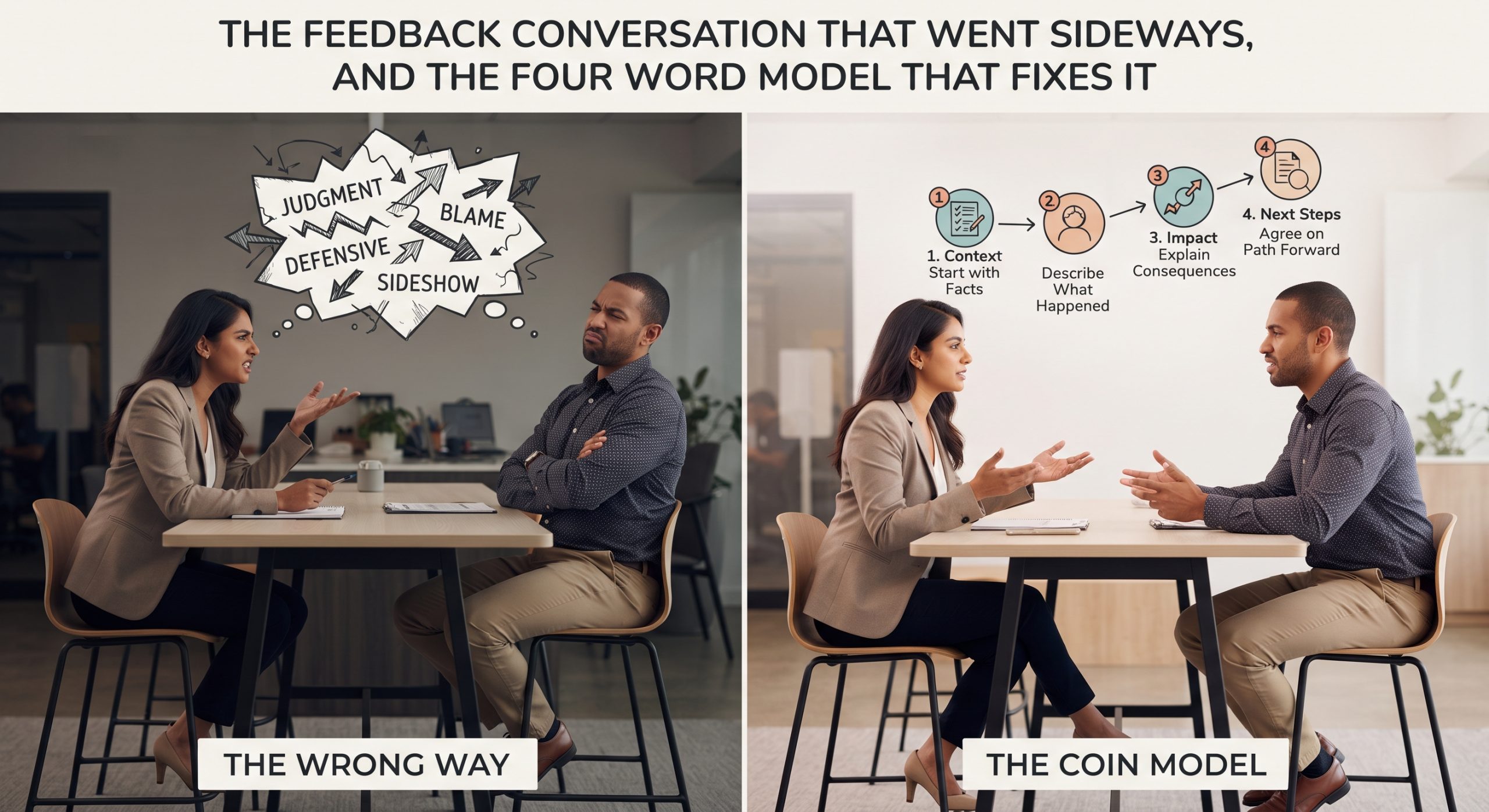
What it sounds like when a feedback conversation goes wrong
Picture a fairly ordinary scene. A team lead named Priya pulls a team member named Marcus aside after he has missed a second deadline on a client deliverable.
Priya: Hey Marcus, got a sec? I wanted to chat about the Hendricks deliverable.
Marcus: Sure, what’s up.
Priya: So this is actually the second time this quarter something has slipped, and it’s starting to become a pattern. You need to be more on top of your deadlines, this is pretty basic!
Marcus: Well, I was waiting on legal to sign off on the contract language, that wasn’t really on me.
Priya: Okay, but you could have flagged that earlier instead of just letting the date slide.
Marcus: I did flag it, I sent you a message about it last Tuesday.
Priya: I didn’t see anything, why didn’t you make sure I did? Anyway, I need you to be more proactive going forward.
Marcus: Sure. Got it.
_________________________________________________________________________
Sound familiar?
Notice what actually happened there. Priya opened with a judgment rather than a fact, calling it a pattern before either of them had agreed on what happened. Marcus immediately got defensive because the first thing he heard was a character conclusion.
He got defensive, blaming others. And Priya ignored his challenges, and focused on future behavior rather than trying to understand Marcus’ point of view.
Once he pushed back, the conversation turned into a dispute over who said what, and by the end neither of them had landed on anything concrete. Marcus leaves the conversation quietly resentful, Priya leaves it unsure whether anything will actually change, and the underlying issue, whatever it really was, is still sitting there unresolved.
This is an extremely common shape for feedback to take, and it is rarely a character flaw on either side. It is a structure problem. Priya skipped straight to judgment and instruction without ever anchoring the conversation in a specific, agreed upon fact, and that single missing step is usually enough to derail everything that follows.
The COIN model, and why it works
COIN is a simple four-part structure for feedback conversations, and it stands for Context, Observation, Impact, and Next steps. The order matters as much as the content, because each step is designed to keep the conversation grounded in something the other person can actually agree with before you move on to what needs to change. Here is the same conversation between Priya and Marcus, run through COIN instead.
Context
Start by naming the specific situation you want to talk about, with enough detail that there is no ambiguity about what you mean. This step alone prevents most of the defensiveness that shows up later, because you are not yet making a judgment, you are simply making sure you are both talking about the same event.
Priya: Hey Marcus, do you have a few minutes? I wanted to talk through the Hendricks deliverable that was due last Friday.
Marcus: Sure, what’s up.
Observation
Describe what you actually saw or experienced, using facts rather than interpretations. This is the part people tend to skip, jumping straight from context to conclusion, and it is exactly where Priya went wrong the first time around. An observation should be specific enough that a neutral third party watching the same events would describe them the same way.
Priya: The deliverable ended up going out three days late, and this is the second time this quarter that a deadline has slipped on something you were leading.
Marcus: Yeah, that part’s fair. I was waiting on legal to sign off on the contract language, and that pushed things back.
Priya: Got it. I wasn’t aware of that.
Notice that because Priya stuck to a fact rather than a character judgment, Marcus does not need to defend himself yet. He can simply confirm what happened, and he even volunteers the context around the delay on his own, which sets up a much more useful conversation than the first version did.
Impact
Explain the effect the situation had, on the client relationship, on the team, on you, or on the broader project, and be specific about it. This is the step that helps the other person understand why this actually matters, rather than feeling like they are being criticized for its own sake.
Priya: The client mentioned it during our check in call, and it put us in an awkward spot since we had told them this was on track. It also meant Aisha had to scramble to cover the gap before the call, which wasn’t really fair to her.
Marcus: Oh ok, I didn’t realize it got mentioned on the call. I’m sorry that impacted Aisha. I could have flagged the legal delay to you directly instead of just hoping it would resolve in time.
This is often where real ownership begins: once someone understands the downstream impact, they are more likely to respond constructively than if they simply feel criticized.
Next steps
Close by agreeing on what happens differently going forward and make it a conversation rather than a directive if you can. Asking the other person what they think should change first often produces a better and more durable commitment than simply telling them.
Priya: In future, what do you think would help you flag something like this earlier, before it becomes a deadline problem?
Marcus: I’d like to work more collaboratively with you, and be able to contact you directly the moment something’s blocked, rather than assuming it’ll sort itself out. I can also loop you in on the legal thread from the start next time so you’re not hearing about delays after the fact.
Priya: That would help a lot. Thank you. Let’s do that, and if legal is ever the bottleneck again, come find me and I’ll help resolve it before the deadline. How does that sound?
By the end of this version, Priya and Marcus have agreed on what happened, why it mattered, and what will actually change, and Marcus has proposed most of the solution himself, which makes him far more likely to follow through on it.
Why the order matters more than the words
The specific language above is far less important than the sequence it follows.
Context before the observation prevents confusion about what is even being discussed.
Observation before impact prevents the conversation from becoming a character debate, but puts forward an idea which both parties can agree on.
Impact before next steps gives the other person a genuine reason to want things to change, rather than just complying because they were told to.
Next steps built together rather than handed down tend to actually stick, because the other person had a hand in designing them.
Most managers already know their message. What COIN provides is the container that keeps that message from getting lost in defensiveness, tangents, or vague generalities. It will not make a difficult conversation comfortable, and it should not, but it gives you a far better chance of walking out the other side with something actually resolved.
If your team could use practice with this
Knowing the COIN model on paper and actually delivering it under pressure, in real time, with a real person reacting in front of you, are two very different skills. That gap is exactly what our Art of Feedback program is built around, using trained actor coaches to role play realistic, sometimes uncomfortable feedback scenarios so your managers can practice landing this kind of conversation before it matters. If that sounds useful for your team, we would be glad to talk through what that could look like.